


3A Molecular Sieve For Chlorobenzene Drying
As one of the most professional manufacturers of famous brands' 3A Molecular Sieve, we warmly welcome you to buy the 3a molecular sieve for chlorobenzene drying in stock from us. Low price and excellent after-sale service will be offered.
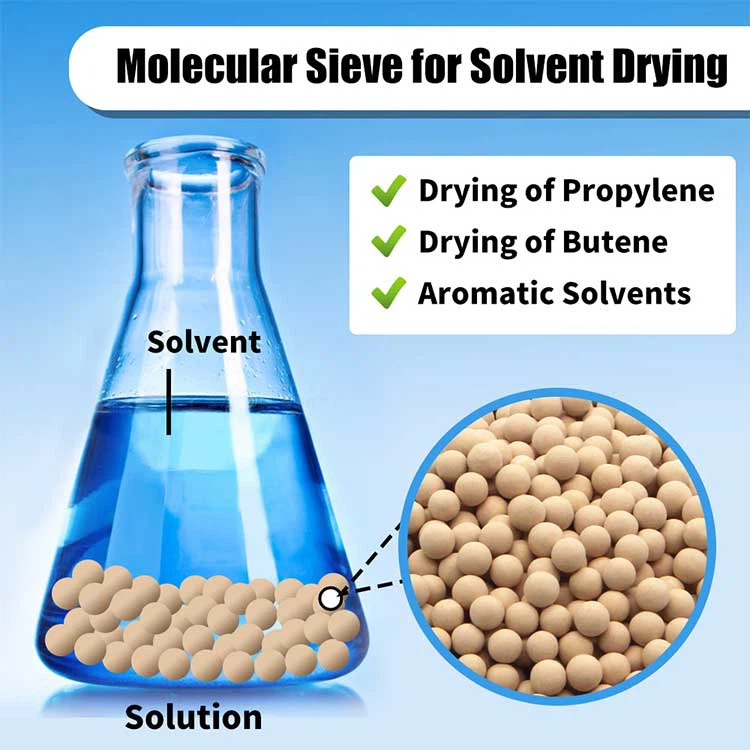
3A Molecular Sieve is an alkali metal aluminosilicate with a pore size of 3A and a potassium type A crystal structure. It is mainly used to adsorb water and does not adsorb any molecules with a diameter larger than 3A.
Chemxin 3A molecular sieve has the advantages of faster adsorption speed, more regeneration times, higher crushing strength, stronger anti-pollution ability, greater utilization efficiency and longer service life. It is the first choice desiccant necessary for deep drying, refining and polymerization of gas and liquid phases in the petroleum and chemical industries.

Chlorobenzene (C₆H₅Cl) is an important intermediate in the organic chemical industry, widely used in the synthesis of dyes, pharmaceuticals, pesticides, and polymer materials. However, residual water in the chlorobenzene production process can significantly reduce product purity, trigger side reactions, and corrode equipment pipelines. Therefore, efficient drying is a critical step to ensure chlorobenzene quality. Molecular sieves, with their precise adsorption characteristics, offer significant advantages in chlorobenzene drying and are gradually replacing traditional drying methods as the industry standard.
1. Necessity of Drying Chlorobenzene
Process Stability: Water participating in the chlorination reaction can produce by-product dichlorobenzene, reducing the target product yield by 15%-20%.
Equipment Protection: Water in chlorobenzene can generate hydrochloric acid in condensation systems, which corrodes stainless steel equipment.
Product Compliance: International standards (e.g., ISO 9001) require chlorobenzene water content <= 0.05%; exceeding this prevents its use in pharmaceutical-grade phenol and other syntheses.
2. Traditional Drying Methods
2.1 Anhydrous Calcium Chloride Drying
Limited adsorption capacity (1 g of CaCl₂ can only adsorb ~0.3 g of water).
Dissolved calcium chloride forms an acidic solution, which corrodes equipment.
Residual calcium ions in dried chlorobenzene result in low dehydration precision.
2.2 Azeotropic Distillation
Separates water based on boiling point differences; however, it is energy-intensive and costly.
3.
Molecular sieves (e.g., 3A type) achieve precise adsorption through pore size selection, offering distinct advantages:
Adsorption Selectivity: 3A molecular sieves with 0.3 nm pores selectively adsorb water while completely excluding chlorobenzene (molecular diameter ~0.6 nm).
High Adsorption Capacity: 1 g of molecular sieve can adsorb approximately 22% water by weight, seven times that of calcium chloride.
Excellent Regeneration Performance: Molecular sieves can be regenerated by heating and reused over 500 cycles.
4. Water Adsorption Operation
Operation Methods: Chlorobenzene can be dehydrated by soaking with stirring or by passing the solvent through a bed of molecular sieves for sufficient contact.
Molecular Sieve Dosage: The amount should be calculated based on solvent water content and processing volume. Adequate loading is recommended to achieve water content at the lowest PPM level.
Flow Rate Control: The solvent should not flow too quickly through the molecular sieve; sufficient contact time is necessary to maximize adsorption efficiency.
Cool tags: 3a molecular sieve for chlorobenzene drying, manufacturers, brands, low price, in stock
Hantar pertanyaan
